Bringing Montessori Home
What It Looked Like in Our House
For a long time, Montessori felt like something that belonged in a classroom, not at home.
I work at a Montessori school, and over the past year I’ve spent a lot of time observing how children move through carefully prepared spaces. I’ve watched how independence grows when materials are visible, when choices are clear, and when adults step back just enough to let children lead their own work. And then I would come home.
Our house looked like what many family homes look like. Cube shelves filled with bins. Labels we made years ago when my son was five. Books stacked and overflowing. Legos technically “organized,” but mostly dumped out or ignored. We had plenty of good materials, but they were hidden, mixed together, or out of reach. The more time I spent at our Montessori school, the harder it became to ignore the disconnect.
This year, I decided to do something about it.
A Different Kind of Christmas Gift
When Christmas came up, I told my kids that their gift this year wasn’t going to be something I bought at the store. Instead, I was going to reorganize our home.
I wasn’t sure how they would react, but to my surprise, they were excited. They understood what I meant. They wanted a space that worked better for them. That mattered to me, not just because it saved money, but because it modeled something important. Gifts don’t always have to be objects. Sometimes time, effort, and an act of service can be the most meaningful things we can offer.
Realizing the Environment Was the Issue
I have been formulating these thoughts for a long time in my mind. However, before I redid anything I simply sat down and just envisioned what were things that needed to be adapted to better serve my kids.
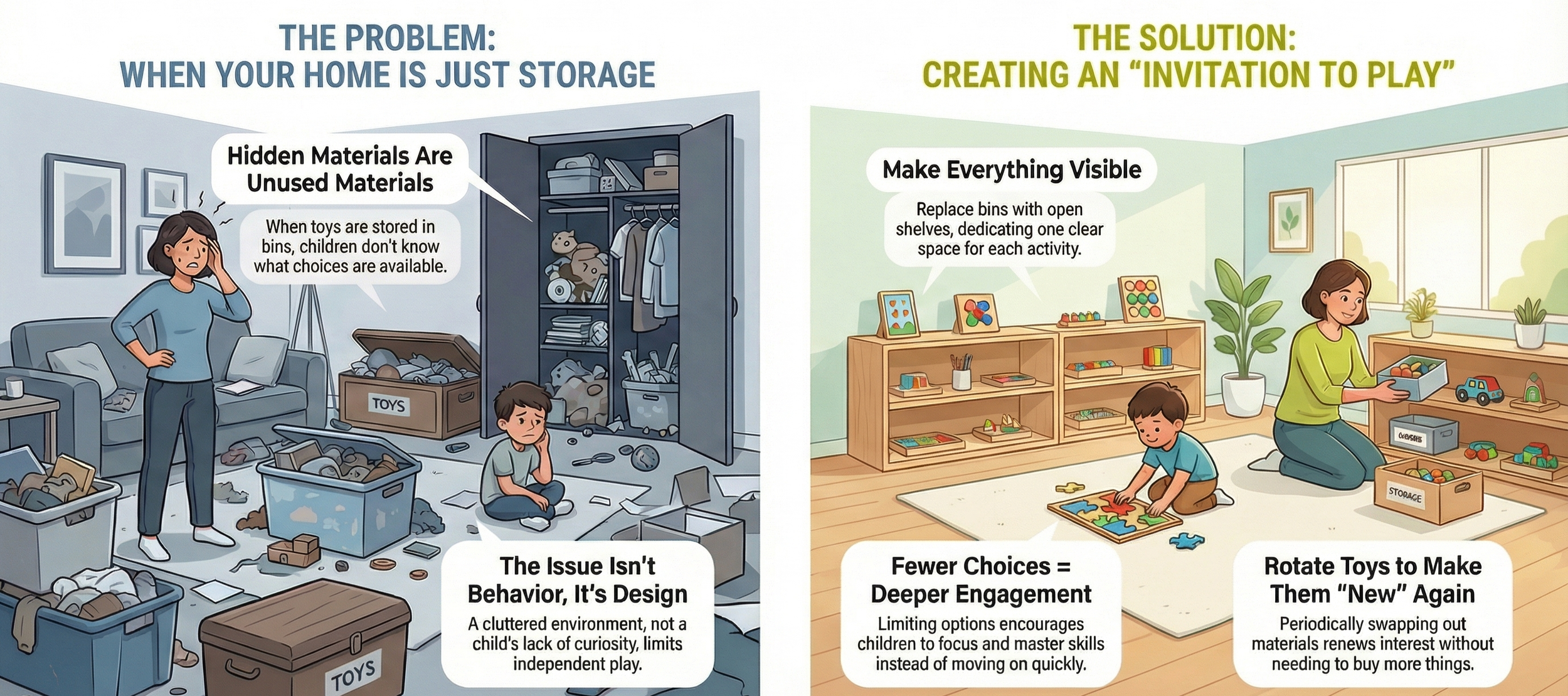
First, we had cube organizers filled with those 12 inch canvas totes. Each tote was labeled, but you couldn’t actually see what was inside. Over time, the labels had fallen off, activities had been mixed together, and the system had become stagnant. The shelves were doing a good job of storing things, but they weren’t inviting use.
What I realized was simple but important. My kids didn’t know what was available to them unless I pulled it out. When materials were hidden, they weren’t chosen. When choices weren’t clear, my kids defaulted to the things they had already known. It is not because they lacked curiosity, but because the environment wasn’t fostering curiosity. The issue wasn’t behavior. It was design.
Changing the Space Without Buying Anything
I didn’t buy new shelves. I didn’t purchase special Montessori materials. I didn’t redesign our house.
Instead, I used what we already had and made a few intentional changes. I removed most of the bins, put out fewer activities at a time, and made everything visible. Each cube began to hold one clear activity. Nothing was stacked or buried. Some spaces were left empty on purpose. Instead of functioning as storage, the shelves became invitations.
That shift changed everything. Almost immediately, my kids began choosing activities on their own. They stayed with them longer. They took more care putting things back, because each item had a clear place. The environment began doing the work I had been trying to do verbally.
Why Fewer Choices Led to Deeper Engagement
One of the hardest adjustments for me was letting go of the idea that my kids needed access to all of their toys at once. I began to realize that curiosity doesn’t come from endless options, but from repeated engagement with fewer materials.
What I saw instead was deeper focus. With fewer choices available, my kids returned to the same work, refined their skills, and engaged with more intention rather than bouncing from one thing to another. I started rotating materials instead of leaving everything out all the time. When something rested for a while and then returned, it felt new again, without needing to buy anything.
A Living, Evolving Home
Our house is still a house. It still gets messy, and things still end up in the wrong place.
The difference now is intention. Instead of managing behavior, I pay closer attention to the environment. Instead of controlling choices, I make those choices visible. Instead of adding more, I simplify.
Bringing Montessori home for me didn’t mean copying a classroom or owning perfectly curated materials that follow a beautiful progression. It meant working with what we already have and trusting the process. Most families already have everything they need to begin and are likely doing more right than they realize. My hope is that this sparks a few small tweaks you can make in your own home to foster independence, confidence, and curiosity in your children’s everyday lives.