The Montessori Method at Home
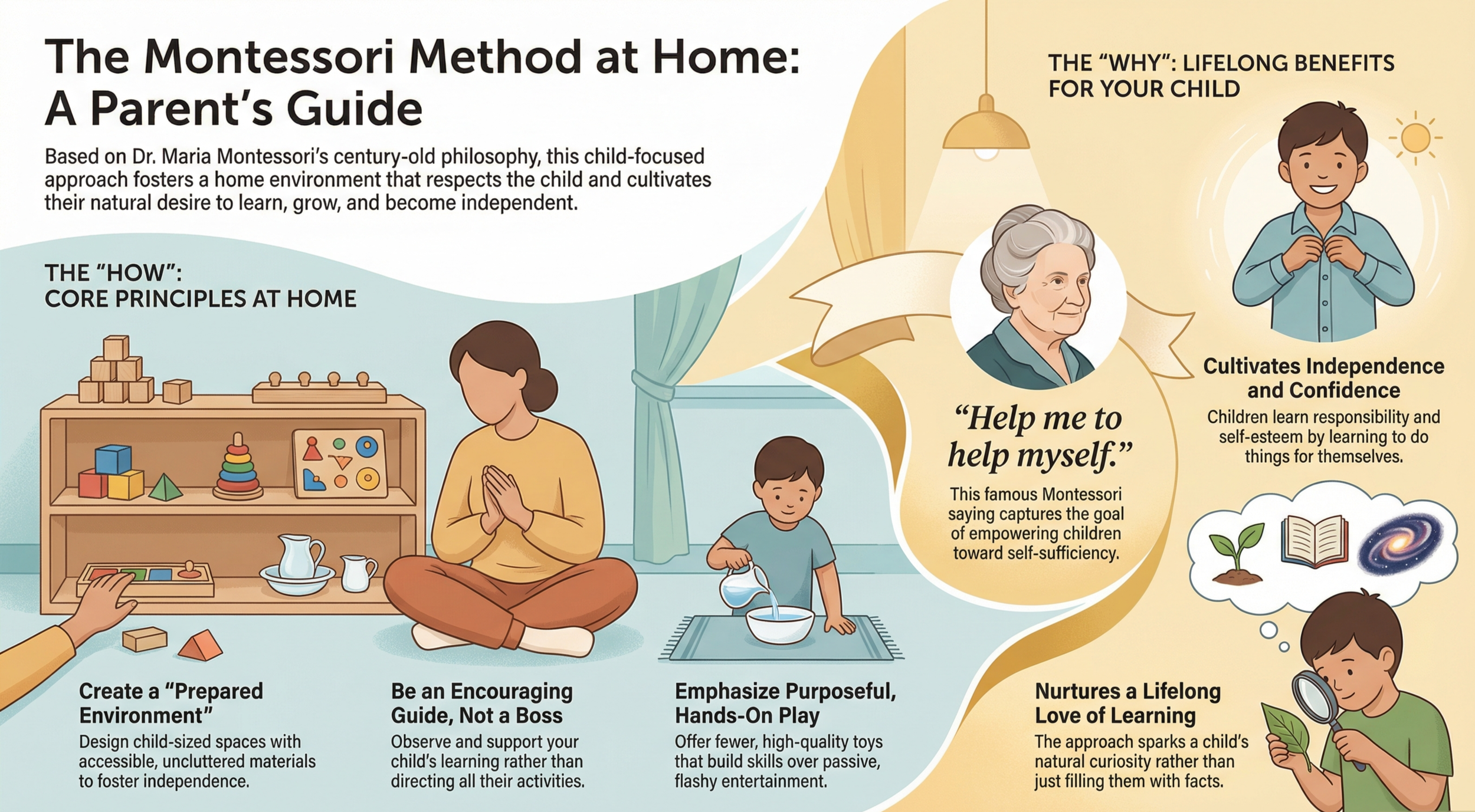
Bringing Montessori Home
A Practical Guide for Real Families
If you have ever looked at a Montessori home online and thought, “That looks beautiful, but that is not my house,” you are not alone. Montessori at home is not about perfection. It is not about buying new shelves or owning the full sequence of materials. Montessori is a way of thinking about children and a way of setting up the home so your child can participate in real life with more independence and confidence.
A simple way to think about Montessori at home is this: prepare yourself, prepare the environment, then let your child show you what they are ready for (YT).
Step 1: Start With the Adult, Not the Shelves
Most Montessori-at-home attempts fall apart for one main reason: we change the room, but we do not change our role.
In Montessori, the adult is not a performer or a constant problem solver. The adult is a prepared, steady presence who observes, makes thoughtful adjustments, and gives lessons only when needed. Observation is not passive. It is how we decide what to put out, what to remove, and when to step in (AMI).
A helpful mindset shift is to ask, What is my child trying to do? instead of What are they doing wrong?
When we lead with observation, power struggles tend to decrease. We stop trying to manage everything with words and start letting the environment carry more of the structure (AMI).
Step 2: Build a Prepared Environment in a Normal House
Montessori uses the phrase prepared environment to describe a space where children can move, choose, and work within clear boundaries. In authentic Montessori environments, materials are accessible, displayed for free choice, and designed to support hands-on learning.
At home, this does not mean duplicating a classroom. AMI guidance is clear that the home and school should complement each other, not copy each other (MAF).
A helpful place to start is with three questions:
Can my child see what is available?
Can my child reach what they are allowed to use?
Does my child know where things go when they are finished?
If the answer is no, that is often the real reason behind dumping toys, bouncing from activity to activity, or defaulting to screens.
Step 3: The Shelf Principle That Changes Everything
A lot of Montessori at home becomes realistic when you embrace one simple idea: display choices instead of storing everything in a mystery box.
Think of it like walking into a store. If everything you might want is hidden in boxes, it is hard to choose. If too many options are competing for attention, it becomes overwhelming. Children experience the same thing.
In many homes, toys and activities are technically organized, but they are hidden in bins or clustered together. While this looks tidy to adults, it makes it harder for children to know what is available or what to do.
Montessori environments are designed so children can see and access their choices easily. Accessible shelves, a simple setup, and a small number of activities available at one time make independent choice possible (YT). A practical way to apply this at home is simply to open up what is hidden.
If you have cube shelves with bins, you don’t need new furniture. Try removing some of the bins, keeping fewer items out at once, and placing one clear activity in each space. Leaving some spaces empty on purpose reduces overwhelm and makes it obvious what to do. Over time, this creates a calmer space and supports more focused, independent play.
Step 4: “Less Is More” Is Not a Trend, It Is a Focus Tool
Many parents assume children need access to everything in order to stay engaged. Montessori pushes the opposite direction: fewer, more purposeful choices often lead to deeper concentration.
Guidepost’s Montessori-at-home guide explains this well by encouraging families to reduce clutter, organize materials in smaller sets, and rotate based on observation (GP).
Your shelves do not need to be full. A short, clear menu beats a huge buffet. When children are not overwhelmed, they revisit work, refine skills, and build the attention span many families are trying to support (AMI).
Step 5: Practical Life Is the Fastest Path to Independence
If you want the most “Montessori” results at home without buying Montessori materials, start with practical life.
In Montessori, practical life refers to everyday activities that help children learn to care for themselves, care for their environment, and move with purpose in the world. This includes pouring, cleaning, dressing, food preparation, and learning how to interact respectfully with others. These activities build coordination, concentration, independence, and confidence while helping children feel like capable members of the family (AMI).
At home, practical life might look like a child wiping the table after a meal, pouring their own water, putting on their shoes, folding a cloth, or watering plants. The goal is not speed or perfection. The goal is practice, repetition, and participation.
Closely connected to practical life is grace and courtesy, which focuses on how we treat one another. Grace and courtesy lessons help children learn social skills such as waiting for a turn, offering help, using polite language, and resolving small conflicts respectfully. At home, this often looks like modeling how to ask for help, practicing how to interrupt politely, or showing a child how to offer a toy to a friend.
The American Montessori Society describes practical life as a hallmark of Montessori education because it helps children learn to care for themselves, others, and their environment in meaningful, real-world ways that families can easily adapt at home (AMS).
One key Montessori guideline is this: invite, do not force. When practical life becomes a power struggle, it stops doing its job. Offering opportunities and modeling the work allows children to join in when they are ready (AMI).
Step 6: Supporting Reading and Math Without “Academics”
A Montessori home does not need worksheets to support literacy and math. The goal is to give children real reasons to read, write, count, measure, and solve problems through daily life.
Literacy can be supported by making books visible and reachable and by giving children meaningful reasons to write, such as card-making stations, journals, lists, or open-ended craft materials. Montessori environments emphasize purposeful materials and self-directed choice as key drivers of motivation (AMS).
Math naturally shows up through practical life and play. Counting, sorting, matching, building, comparing quantities, and noticing patterns all support early mathematical thinking. Montessori environments are designed for concrete exploration that later supports abstract understanding, and this can begin naturally at home through hands-on work (AMI).
Step 7: The Rhythm That Makes This Sustainable
Most families do not need a full overhaul. What they need is a repeatable rhythm.
Observe what your child chooses repeatedly, what they avoid, and what looks like “misbehavior” but may actually be a need for access, order, or movement.
Edit the environment by reducing clutter, simplifying choices, making materials visible, and making cleanup obvious.
Offer one small lesson. Show how to start, how to use materials, and how to restore them. Then step back.
Rotate materials based on what you observe.
This is how Montessori becomes a lifestyle rather than a weekend project.
How can I start this week?
If you want a low-pressure entry point, start here.
Choose one area, not the whole house.
Remove what is not being used.
Make what remains visible and reachable.
Place one activity per space.
Leave some empty space.
Watch what your child chooses for three days.
Then adjust.
Closing Thought
Montessori at home is not about building a perfect room. It is about building trust, one small system at a time. When children can see what is available, reach it, use it with purpose, and restore it, they begin to feel capable. That capability shows up as confidence, calmer days, and a home where children can truly participate.
Most families already have what they need. A few thoughtful tweaks can change the whole feel of a home.
Sources for Further Learning
American Montessori Society (AMS)
Montessori at Home course overview The American Montessori Society
Core components of Montessori The American Montessori Society
Practical life at home guide The American Montessori Society
Association Montessori Internationale (AMI)
Montessori environments Association Montessori Internationale
Observation and Intervention (PDF) Association Montessori Internationale
Prepared adult and practical life guidance Association Montessori Internationale
AMI USA (AMI/USE)
Montessori in the Home AMI/USA
Prepared environment collaboration article AMI/USA
Guidepost Montessori (GP)
The Ultimate Guide to Montessori at Home Guidepost Montessori
Maria Montessori Institute (MMI)
Creating a Montessori learning environment at home Maria Montessori Institute
Montessori Australia Foundation (MAF)
Montessori in the Home Environment Montessori Australia Foundation
YouTube (YT)
Montessori at Home: What is Montessori and why do it YouTube
Montessori at Home: How to start in 5 steps YouTube